

Private Pay Reimbursement Guide
Your mental health deserves a sanctuary with total privacy, billing discretion, digital security, and freedom to choose & explore.
At Jupiter Pines Counseling, we believe that true healing requires both a secure foundation and the freedom to expand. Private-pay is our commitment to your freedom, autonomy, and healing without compromise.
For many clients seeking maximum privacy and billing discretion, especially during sensitive seasons of life (e.g., identity exploration, navigating a divorce, or prioritizing total privacy), Private Pay can be the financial framework to an unburdened mental health journey. The choice to pursue Out-Of-Network Reimbursement from a health insurance company always remains yours. You retain full ownership of your narrative and become the gatekeeper for any details reported to traditional insurance.
For those worried about solutions for cash flow hurdles or tools automate reimbursement claims to their insurers, we’ve got you covered too!
quick links:Why Choose Private Pay?
Finding Secure Ground in Total Privacy
In moments of vulnerability, we know that the fear of exposure can weigh on clients as a heavy burden. The framework of private pay at Jupiter Pines Counseling can offer these clients immediate relief by removing some of that burden. Self-pay protects the following benefits for our clients:
1. Maximum Privacy & Clinical Protection
Your mental health journey remains confidential between you and your therapist, protected and secluded.
Receiving a monthly Superbill in your own name keeps the details of your therapy session off of any primary policyholder’s monthly explanation of benefits (EOB).
Clients remain the gatekeeper of their privacy until they choose otherwise. Any diagnosis codes (required for some insurers) or appointment details are visible to you before submitting any claims to your insurer.
2. Freedom of Choice, Freedom to Explore
Self-pay releases you from being locked into a "network" of therapists. You can choose Jupiter Pines Counseling because our approach resonates with you, not because we are the only option on your insurance list.
Self-pay avoids insurance-mandated limits on session frequency or type of therapy (e.g., being forced to stop after 12 sessions just because "the plan says so").
Whether you are questioning your identity, processing the end of a marriage, or redefining intimacy, self-pay grants you the freedom to speak openly without the constraints of third-party oversight.
3. Potential Cost Savings
Your insurance deductible may already be met, meaning you could get reimbursed at 100% even though the session is "out-of-network."
You avoid high co-pays for out-of-network providers that some plans charge.

Who Benefits Most from Maximum Privacy & Discreet Billing?
While privacy is valuable for everyone, paying privately can offer potentially life-changing protection for individuals navigating high-stakes situations where confidentiality is essential to their safety, career, or identity. The following groups often find that private pay and reimbursement are not just a financial choice, but the only way to access care without fear of unnecessary exposure.
-
If you are still living with an abuser or toxic partner who controls the finances and health insurance, receiving a Superbill in your own name (or via an app) can keep the details of your therapy sessions off the primary policyholder's monthly explanation of benefits (EOB).
-
For those navigating complex administrative hurdles (e.g., immigration statuses), accessing public benefits or having detailed medical records linked to government databases can sometimes create additional unintended barriers. Using private methods ensures that therapy remains a personal matter rather than part of a government-recorded health history.
-
Parents often worry about their children's mental health history being accessible to future employers or insurers. Private pay allows you to keep that information confidential.
-
In contentious legal separations, the opposing party often has access to family health insurance records (including Explanation of Benefits statements). Private pay ensures that therapy regarding trauma, asset splitting stress, or co-parenting dynamics remains completely invisible to your soon-to-be-ex-partner and their legal team.
-
Many individuals delay seeking support for gender transition or questioning sexual identity due to fear of being "outed" by an insurance card or billing statement. Private pay allows you to explore these core aspects of your identity with a specialized provider without triggering automated alerts or letters to a spouse, parents, or partners on the primary policy.
-
Celebrities, politicians, influencers, and media personalities often face intense public scrutiny. A pattern of mental health claims appearing on a public record (or leaked via data breaches) can become a weaponized headline. Private pay allows them to maintain their career trajectory and public image while receiving essential care.
-
Avoid putting sensitive diagnoses on a permanent insurance record that might impact security clearance, promotions, or future employment.
-
For those in polyamorous relationships, open marriages, or complex relationship constellations, insurance billing can inadvertently complicate relationships. Private pay maintains the boundaries of each unique relationship dynamic.
-
Trauma related to sexual violence, or the processing of kink/BDSM dynamics that may be stigmatized by mainstream providers or misunderstood by insurance auditors, requires a high degree of discretion. Receiving a generic "therapy session" description via private pay avoids the potential judgment or flagging that might occur with specific diagnostic codes used for intimate trauma.
-
For individuals currently being stalked, the insurance billing address or EOB notifications can sometimes be intercepted by an abuser who has access to a shared mailbox or digital account. Private pay allows for therapy that is completely decoupled from the primary household's financial infrastructure.
-
Senior leadership, board members, and executives in highly competitive industries may fear that a diagnosis of "stress," "anxiety," or "burnout" could be perceived by a future employer or competitor as a weakness during background checks for new roles. Private pay keeps their mental health record strictly private, between the client and clinician.
Three Steps to Your Reimbursement
Expansive & Secure Care, SimplifiedJupiter Pines Counseling supports your journey with seamless financial tools.
We understand that prioritizing your mental health shouldn't create financial friction. While you pay privately upfront to maintain your privacy, we make it easy for many of our clients to reclaim those costs through Out-of-Network Reimbursement.
Think of this process not as a bureaucratic hurdle, but as a smooth stream flowing back to you. We streamline the path to your wallet so you can focus entirely on your growth.
How It Works:
-
Each month, we can automatically provide a detailed "Superbill" document containing all necessary CPT codes for your health insurance claim.
-
Many insurance companies have superbill submission processes that are relatively simple. However, some of our clients prefer to use a direct reimbursement app like Thrizer, Reimbursify, or Mentaya. These tools connect directly to your bank and insurance portal and make the superbill submission process as simple as sending a text.
-
Once processed by your provider (typically within days), funds are deposited back into your account. Note: Reimbursement rates vary by health insurance plan; we do not guarantee specific reimbursement amounts, but our team is here to guide you.

Overcoming Cash Flow Hurdles
We understand that paying $200+ upfront can feel daunting at times, even if you know funds will return later. Here are some ideas to help manage the flow of investing in your mental health:
01
HSA/FSA Cards
Many clients use their Health Savings Account or Flexible Spending Account debit card to pay for sessions immediately. This makes the cost feel "free" as long as you qualify under your plan rules.
02
Credit Card Rewards
Use a rewards credit card to earn reward points or flight miles for your next vacation while waiting for reimbursement. For those that can connect reimbursement deposits with their credit card balance, this results in a nice credit score boost along with their mental health and vacation!
03
Budgeting for Reimbursement
Treat your expected insurance reimbursement as an annual refund. Many clients budget the out-of-pocket cost and plan to "spend" their reimbursement on a vacation, emergency fund, or future self-investment once received.
04
Rapid Apps
Using reimbursement apps, like the ones listed below, can speed up your payout from 2–4 weeks (vs. manual mail or online submissions) to as little as 1–3 days.
Reimbursement Tools
App Comparisons for Those Who Love AutomationIf you prefer manual submission directly to your health insurance, that is perfectly valid. However, for many clients, specialized apps, like the ones below, offer automatic speed and security. Here are how a few of our top recommendations compare:
Thrizer
Best For: Speed & Simplicity
Key Features: Scans your Superbill instantly via camera, integrates with major insurers for instant verification, and offers a user-friendly interface.
Cost Model: Free basic / Premium subscription
Mentaya
Best For: Privacy & Anonymity
Key Features: Focuses heavily on data security with minimal personal data requirements; ideal for those in high-stakes privacy situations (e.g., military, executives).
Cost Model: Subscription based
Reimbursify
Best For: Accuracy & Support
Key Features: Known for high coding verification accuracy; offers a guarantee (sometimes) and customer support if claims are denied.
Cost Model: Pay-per-claim or Subscription
Note: While Jupiter Pines Counseling is not an affiliate of any app, we support the use of all these apps if they are a fit for our clients. We are happy to help you choose which one fits your specific insurance plan best. Feel free to mention this in your initial consultation call.
Common Questions About Private-Pay, Reimbursement, & Superbills
-
Never. Private pay creates a completely invisible trail to your workplace and insurance networks. Your presence at Jupiter Pines Counseling is known only by you. This makes it the ideal choice for those in high-profile roles, creative professionals, or anyone seeking anonymity during sensitive times like divorce a delicate life change.
-
We believe trust is grounded in transparency. Check out our fee schedule and other information on financial transparency. It’s worth noting that for many clients with out-of-network benefits, the net cost after reimbursement is significantly lower, sometimes as little as $40-60 per session or even $0 if your plan offers 100% reimbursement.
We also accept HSA and FSA cards and accept all major rewards credit cards to help you manage cash flow (and rack up those miles!) while you wait for reimbursement.
-
As a private-pay practice, we do not bill insurance directly. This structure empowers you to access out-of-network benefits and ensures your clinical notes remain within your control. Reach out for a complimentary consult whenever you’re ready; we’re happy to help you navigate the reimbursement process once you join us.
-
In-Network: The therapist has a contract with your insurance company, agreeing to accept a pre-negotiated (often lower) rate for their services. You usually pay a small co-pay at the time of service, but you have no control over which therapists are available, and you may face limits on how many sessions are covered per year. Note: Jupiter Pines Counseling is not In-Network with any insurance company.
Out-of-Network: The therapist does not contract with your insurer. You choose any provider based on their expertise and fit, rather than who is on the insurance list. While you pay the full fee upfront, you often get reimbursed a significant portion (or all) of that cost after submitting proof of service. This option grants you the freedom to collaborate with Jupiter Pines Counseling to prioritize your clinical needs over network availability.
-
Absolutely not. Filing an out-of-network claim for therapy is a standard, safe administrative process and will not result in higher premiums or denial of coverage in the future. Your therapist provides a detailed Superbill with billing codes, but unlike a direct bill from an in-network provider, this does not trigger immediate data sharing with your employer. Furthermore, the specific diagnosis code used for reimbursement is protected under HIPAA and generally remains confidential between you and your insurer unless you explicitly authorize otherwise.
-
You (or a third-party app) become the claims filer. Once you pay your session fee, we generate a monthly Superbill, a standardized invoice containing all the necessary codes for insurance reimbursement. You then submit this Superbill to your insurer. We can guide you on how to do this yourself via your health insurance portal, via mail, or recommend user-friendly apps (like Thrizer or Reimbursify) that scan and upload your Superbill instantly, often speeding up reimbursement from weeks to a few days.
-
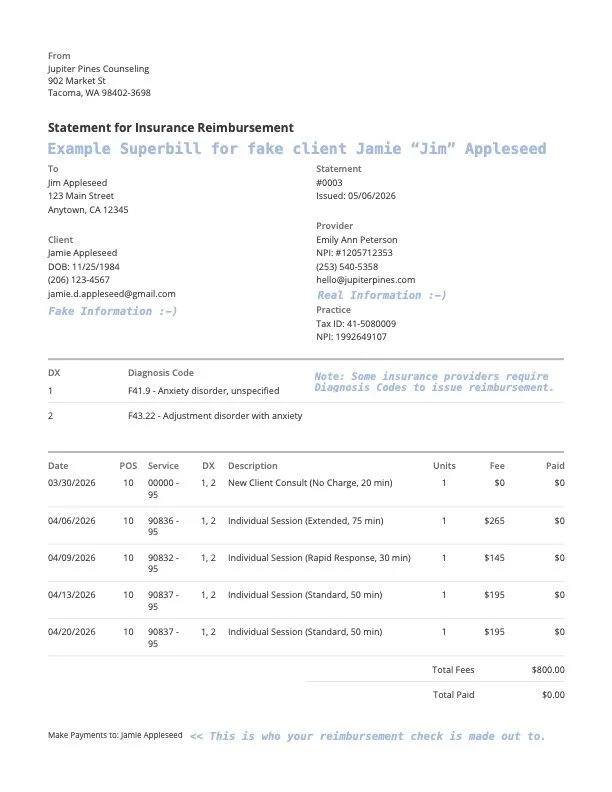
Monthly Superbills issued by Jupiter Pines Counseling are designed to meet all major insurance standards for out-of-network claims. It includes:
Client demographic information, including DOB
Responsible party information, if different from the client (e.g., parent/guardian that paid for sessions)
Client insurance information, if added to the client profile
Provider Information: Name, their License Number, and NPI/Tax ID
Diagnosis code(s); only if required by your plan for reimbursement.
Appointment details: Date(s) of service, Place of Service code (POS), CPT code(s), and service descriptors (e.g., “individual psychotherapy session”)
Amount charged and payments received
Crucially: It does not include detailed clinical notes or session content, ensuring your privacy is maintained.
-
We understand that choosing an app can be overwhelming! We recommend different tools based on your specific insurance plan and tech comfort level. For example:
Thrizer: Best for speed and simple scanning if you want the fastest reimbursement.
Reimbursify: Excellent if you have a complex plan or need extra verification support to prevent denials.
Mentaya: Ideal if privacy is your absolute highest priority, as it focuses on minimal data sharing.
We are happy to discuss options during your initial consultation and help you select the one that works best for your specific insurance carrier. Note: We are not financially affiliated with any of these or similar apps.
-
While paying "cash" feels expensive upfront, most out-of-network plans offer 80% to 100% reimbursement. If you have met your deductible (or if your plan covers out-of-network care before the deductible is met), your net cost per session could be less than a standard $50 co-pay at an in-network provider. Additionally, paying cash allows you to see the therapist of your choice immediately without waiting for "network availability," often leading to faster progress.
We encourage clients to check their specific plan details (via their insurance portal or by calling the number on the back of your insurance card) to calculate your exact out-of-pocket cost vs. reimbursement potential.