
5 Proven Breathwork Techniques to Feel Better & Reduce Anxiety
A Step-By-Step Guide to Calm, One Breath at a Time
(For Clients in Washington State & Beyond!)
When mentioning “self-care” to someone, I (Emily Ann Peterson) am often bracing for an eye roll. I do get it. Self-care gets a bad rap. It’s frequently reduced to bubble baths, mani/pedis, face masks, or worse: “just another reason to feel infinitely guilty about a never-ending to-do list…” If you’re a client of mine, you’ll know that when I’m discussing regular daily self-care practices, I’m *rarely* referring to spending more time with Mr. Bubble.
One of my favorite self-care recommendations is mindful breathing (also referred to as “breathwork”). It’s literally FREE, always accessible, requires zero equipment, and is one of the most powerful tools for managing stress and feeling better physically and mentally.
Umm… Hello?! Free99!?! Yes, please!
According to many research studies (referenced below), integrating a daily practice of mindful breathing into your self-care routine is one of the most effective, low-risk strategies for improving your mental health. So if you’re navigating a high-stress season, facing a major life transition, or simply seeking more calm in your Pacific Northwest workday commute home, taking time for slow breathing could really help provide extra immediate (dare I say instant?) and long-term support.
Who knows, maybe you’ll hear yourself start randomly talking about the importance of self-care someday, too? (Only half-joking, of course.) ;-)
Why Breath Works
The Biology of Feeling Better with Oxygen & Intentional BreathingSafety Note: Watch for Hyperventilation.
As with many things in life, even oxygen can be too much of a good thing. So while breathwork is *generally* safe, pushing too hard or getting too much oxygen can lead to hyperventilation (breathing faster or deeper than your body needs). This can cause dizziness, tingling in hands/feet, or chest tightness. If this happens:
Stop immediately if you feel unwell.
Return to normal breathing. (Don’t force it.)
Consult your doctor if you have a history of panic attacks, lung conditions, heart issues, or are pregnant before starting.
When you practice slow, intentional breathing (typically under 10 breaths per minute), you aren't just "relaxing"; you’re actively shifting your nervous system.
Stress Reduction: Even brief sessions, just 3 to 5 minutes, can yield clinically meaningful results in lowering stress levels (links to all the research studies are below).
Nervous System Regulation: Slow breathing increases Heart Rate Variability (HRV) and boosts parasympathetic tone. In plain English? It teaches your body to switch from the "fight or flight" mode to the "rest and digest" mode. Increasing your body’s ability to switch modes and recognize when it feels secure is known to enhance your resilience to stress (e.g., financial, emotional, and physical).
This means a breathwork practice can help you bounce back after wrangling the next new parent toddler tantrum or the next “Todd tantrum” at the office. 😉
Emotional & Cognitive Clarity: Studies link consistent breathwork to reduced feelings of anger, confusion, and anxiety, and increased feelings of alertness, vigor, and comfort. You might also notice an improved cognitive flexibility and perceived stress reduction; this is a welcome benefit for those of us who are neurodivergent and/or experience symptoms from trauma!
Accessibility: Unlike therapy appointments or medication management, breathwork is free and portable. Even a single two-minute session has been shown to reduce state anxiety. (I’m pretty sure I’ve sat at a red light on 6th Ave or Pacific Avenue longer than that! 😉) For those who face systemic barriers to things like medication interventions or find themselves unable to get the additional psychotherapy support that they might really need or want, a dedicated practice of breathwork is particularly helpful!
5 Evidence-Based Breathwork Techniques to Feel Better & Build Resilience
Belly Breathing (Diaphragmatic Breathing)
for breathwork beginners & stress relief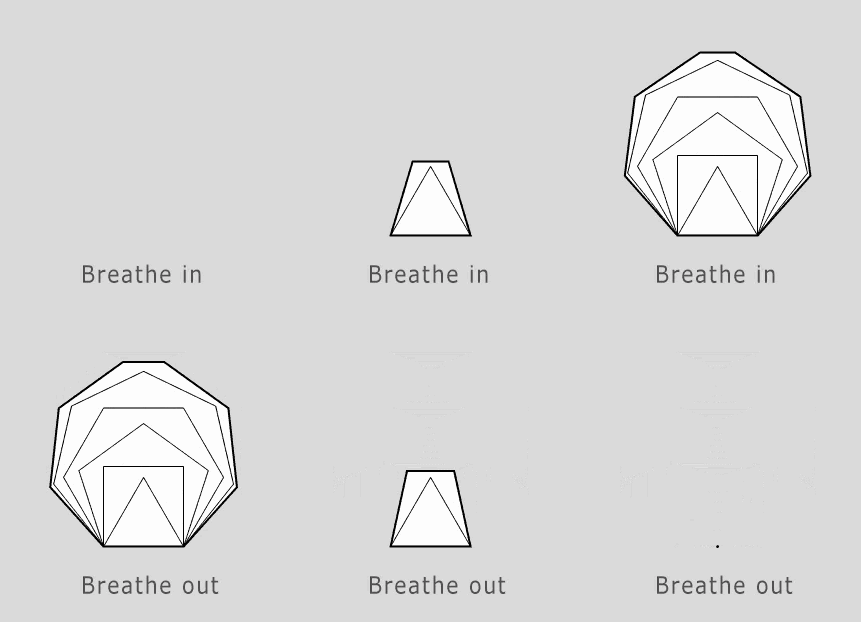
Place one hand on your chest and one on your belly.
When you breathe in slowly through your nose, your belly hand should rise while your chest hand stays mostly still.
Breathe in through your nose for 3–5 seconds, feeling your belly expand like a balloon.
Then breathe out slowly through your mouth for 5–7 seconds, feeling your belly gently fall.
FYI: This type of breathing sends a signal through a major nerve (the vagus nerve) to tell your brain and body it's safe to relax. It lowers your heart rate, blood pressure, and stress hormones.
Best for: everyday stress management, a starting point for breathwork beginners, and practicing a skill before learning other techniques.
Coherent or Resonance Breathing
for daily balance & pacing
Breathe in slowly through your nose for 5 seconds.
Breathe out slowly through your nose or mouth for 5 seconds.
Just keep this steady rhythm going. That’s it!
FYI: You're aiming for about 5–6 breaths per minute. This pace helps your heart, lungs, and brain get 'in sync' with each other, like instruments playing in tune.
Try counting in your head: 'In-2-3-4-5, Out-2-3-4-5.' Practice for 10 minutes daily. You can do it while sitting, lying down, or while walking.
Best for: Building long-term stress resilience, improving emotional regulation, and daily practice.
Box Breathing (Square Breathing)
for panic, acute anxiety & stabilization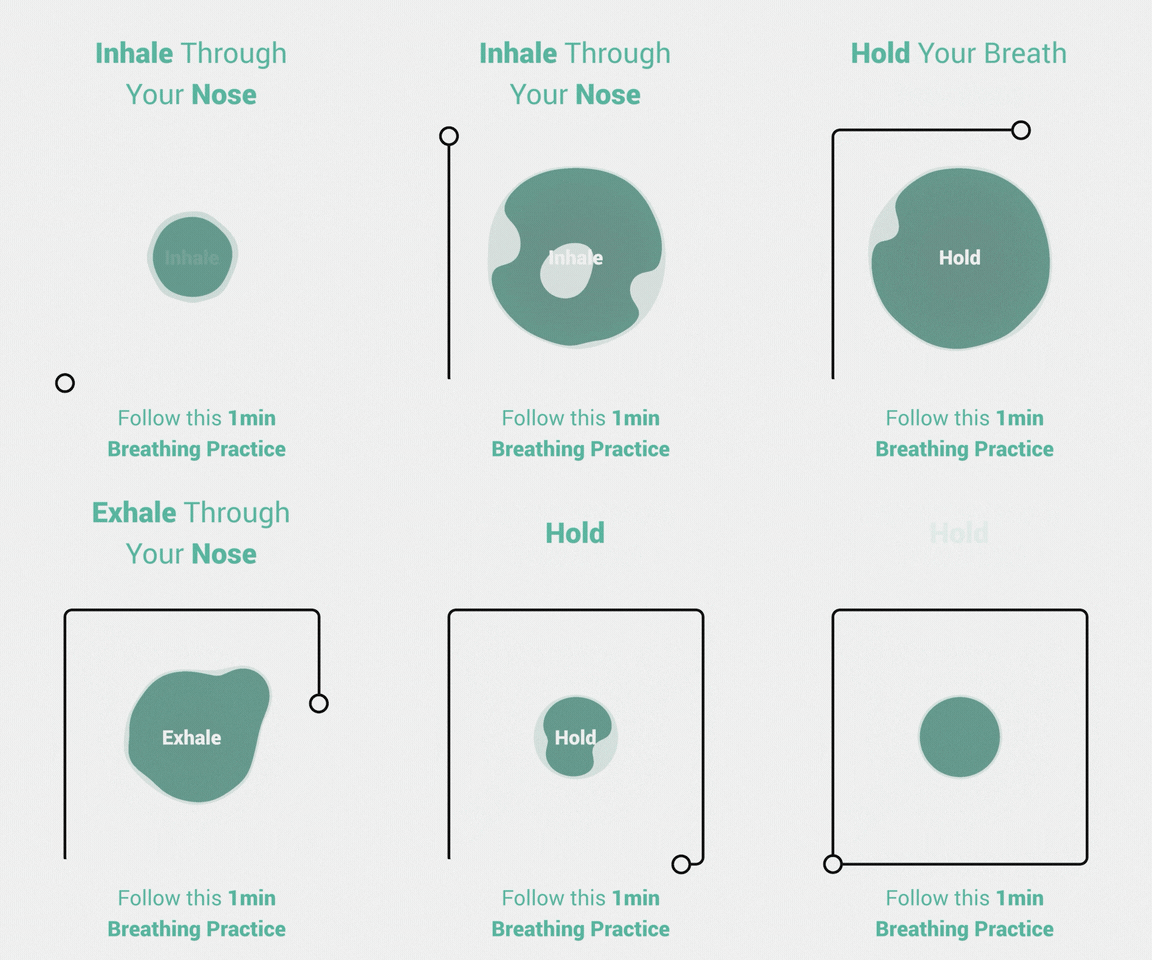
Box breathing uses equal-duration phases, often 4 seconds each for inhale, hold, exhale, hold, for a rate of about 4 breaths per minute. Imagine tracing the four sides of a square with your breath:
Side 1: Breathe IN through your nose for 4 seconds
Side 2: HOLD your breath for 4 seconds
Side 3: Breathe OUT through your mouth for 4 seconds
Side 4: HOLD with empty lungs for 4 seconds
Repeat this cycle 4–6 times, or for 2–5 minutes.
FYI: The holds give your mind something to focus on, which can be especially helpful when your thoughts are racing. It's like pressing a 'pause button' on your stress response.
Best for: Acute anxiety or panic moments, grounding during distressing thoughts, situations requiring quick calming (e.g., before a difficult conversation or exam).
4-7-8 Breathing (The Extended Exhale)
for after work, pre-sleep & deep relaxation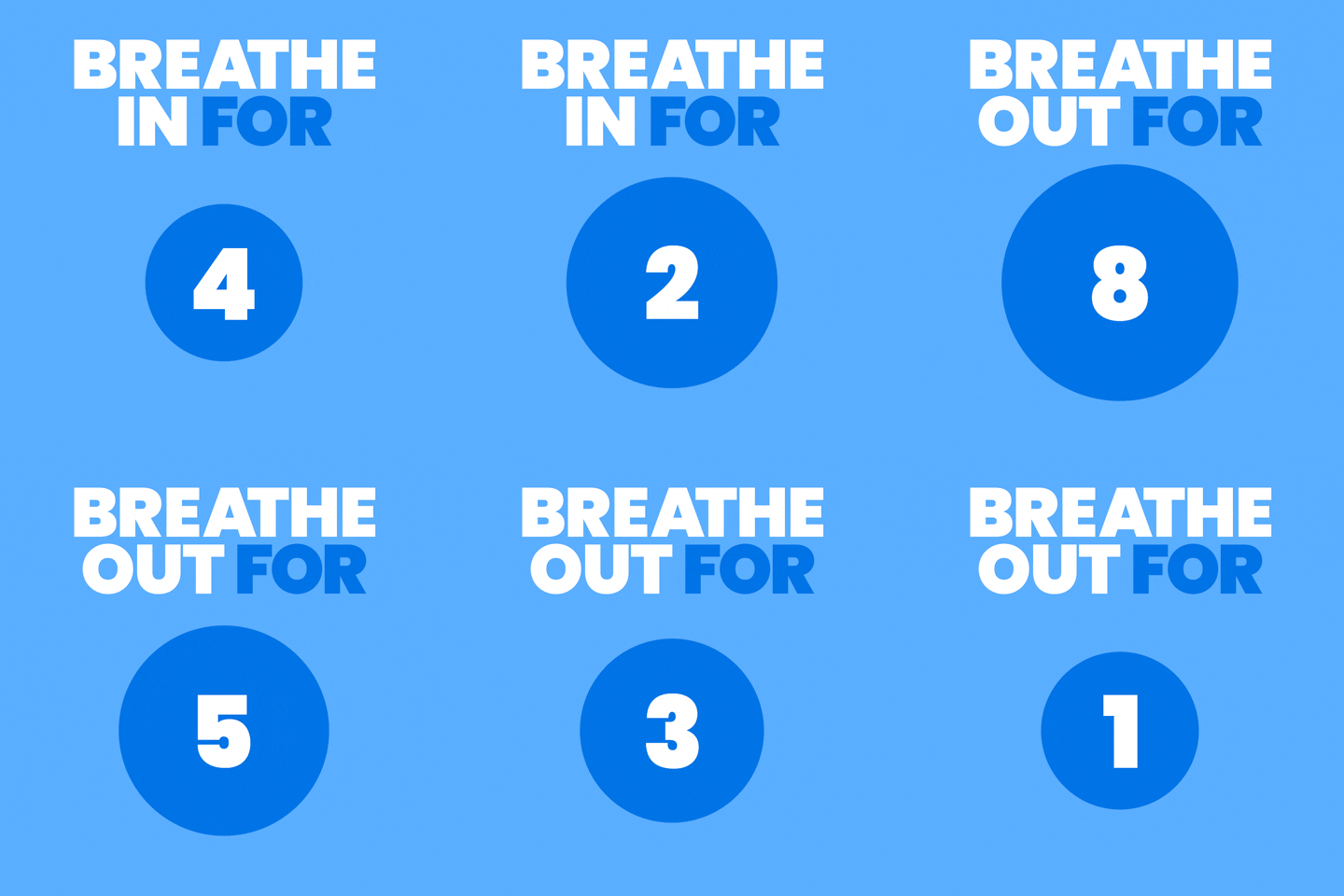
This breathing technique was developed by Andrew Weil and uses a long, slow exhale, like letting air out of a tire:
Breathe IN quietly through your nose for 4 seconds.
HOLD your breath for 7 seconds.
Breathe OUT completely through your mouth (making a gentle 'whoosh' sound) for 8 seconds.
FYI: The slow exhale sends a strong 'calm down' signal to your nervous system.
Pro-Tips: If the 7-second hold feels too long at first, shorten all the counts proportionally (e.g., 2-3.5-4) and build up over time. Start with 4 cycles. As you get comfortable, you can work up to 8 cycles.
Best for: Pre-sleep relaxation, winding down after a stressful day, folks who benefit from a longer exhale to feel calmer.
A52 Breath Method
for integration, mental clarity & physical release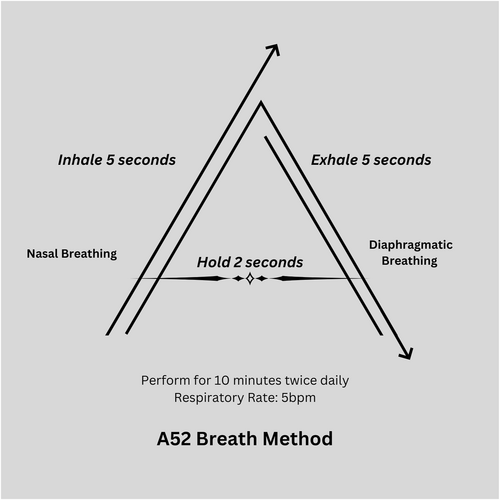
Source: Little et al., 2026
This is a fairly recent evidence-based protocol that combines many of the above techniques into a single standardized method: 5-second nasal inhale, 5-second nasal or mouth exhale, and a 2-second post-exhalation hold, repeated for 10 minutes (~5 breaths per minute).
Breathe IN through your nose for 5 seconds, filling your belly.
Breathe OUT through your nose or mouth for 5 seconds.
After breathing out, PAUSE for 2 seconds before your next breath. Just rest in that stillness.
Repeat for 10 minutes. That's about 5 breaths per minute — much slower than your normal 12–20 breaths per minute.
FYI: That little 2-second pause at the end is like a mini-reset for your nervous system. It gives your body an extra moment to shift into 'rest and recover' mode.
Best for: Clients ready for a structured daily practice, building long-term resilience, and combining the benefits of slow breathing with breath retention.
Bonus factoid: a study in paramedicine students using this breathing method found significant improvements in resilience and psychological well-being while reducing anxiety, depression, stress, *and* insomnia!
-
Shepardson RL, Khan JS, Funderburk JS. I’m Concerned About Anxiety—What Do I Need to Know? JAMA Intern Medicine. Published Online May 04, 2026. https://doi.org/10.1001/jamainternmed.2026.0392
Fincham, G. W., Strauss, C., Montero-Marin, J., & Cavanagh, K. (2023). Effect of breathwork on stress and mental health: A meta-analysis of randomised-controlled trials. Scientific Reports, 13(1), 432. https://doi.org/10.1038/s41598-022-27247-y
Chai, J., Li, S., He, L., Yang, J., Wu, T., Ou, K., Chen, X., Ma, K., & Zhao, S. (2025). Clinical application of abdominal breathing training and evaluation of physical and mental benefits in anxiety patients. Frontiers in Psychology, 16, 1695622. https://doi.org/10.3389/fpsyg.2025.1695622
Zaccaro, A., Piarulli, A., Laurino, M., Garbella, E., Menicucci, D., Neri, B., & Gemignani, A. (2018). How Breath-Control Can Change Your Life: A Systematic Review on Psycho-Physiological Correlates of Slow Breathing. Frontiers in Human Neuroscience, 12, 353. https://doi.org/10.3389/fnhum.2018.00353
Little, Abbie, Matthew Stainer, Alex MacQuarrie, Nicola Wiseman, and Brian Haskins. 2026. “Examining the Effectiveness of Breathwork to Improve Resilience and Psychological Wellbeing While Reducing Anxiety, Depression, Stress, and Insomnia in Paramedicine Students: A Single-Blind Randomised Controlled Trial,” Stress and Health: e70161. https://doi.org/10.1002/smi.70161.
Hooi, L. Y., Chen, P. L., Tan, K. W., de Vries, M., & Wong, H. K. (2025). Effects of mindfulness breathing meditation on stress and cognitive functions: a heart rate variability and eye-tracking study. Scientific reports, 15(1), 37185. https://doi.org/10.1038/s41598-025-23727-z
Zaccaro, A., Piarulli, A., Laurino, M., Garbella, E., Menicucci, D., Neri, B., & Gemignani, A. (2018). How Breath-Control Can Change Your Life: A Systematic Review on Psycho-Physiological Correlates of Slow Breathing. Frontiers in human neuroscience, 12, 353. https://doi.org/10.3389/fnhum.2018.00353
Little, A. L.2025. “The A52 Breath Method: A Narrative Review of Breathwork for Mental Health and Stress Resilience.” Stress and Health: e70098. https://doi.org/10.1002/smi.70098.
Chai, J., Li, S., He, L., Yang, J., Wu, T., Ou, K., Chen, X., Ma, K., & Zhao, S. (2025). Clinical application of abdominal breathing training and evaluation of physical and mental benefits in anxiety patients. Frontiers in psychology, 16, 1695622. https://doi.org/10.3389/fpsyg.2025.1695622
Little, A., Stainer, M., Wiseman, N., & Haskins, B. (2026). Examining the Effectiveness of Breathwork to Improve Resilience and Psychological Wellbeing While Reducing Anxiety, Depression, Stress, and Insomnia in Paramedicine Students: A Single-Blind Randomised Controlled Trial. Stress and Health, 42(2), e70161. https://doi.org/10.1002/smi.70161
Chai, J., Li, S., He, L., Yang, J., Wu, T., Ou, K., Chen, X., Ma, K., & Zhao, S. (2025). Clinical application of abdominal breathing training and evaluation of physical and mental benefits in anxiety patients. Frontiers in psychology, 16, 1695622. https://doi.org/10.3389/fpsyg.2025.1695622
Noble, D. J., & Hochman, S. (2019). Hypothesis: Pulmonary Afferent Activity Patterns During Slow, Deep Breathing Contribute to the Neural Induction of Physiological Relaxation. Frontiers in physiology, 10, 1176. https://doi.org/10.3389/fphys.2019.01176
Czub, M., Kowal, M., Zarazaga, R. E., Serrano-Ibáñez, E. R., Ruíz-Párraga, G. T., Ramírez-Maestre, C., López-Martínez, A. E., Paccione, C., & Piskorz, J. (2024). A slow diaphragmatic breathing intervention for anxiety: How do respiration rate and inhalation/exhalation ratio influence self-reported anxiety? Stress and Health, 40(6), e3496. https://doi.org/10.1002/smi.3496
Riedl, E. M., Bracklo, T., Wimmer, K., Perzl, J., Gdynia, H. J., Thomas, J., & Surzykiewicz, J. (2026). Simply breathing anxiety away? A pilot, just-in-time ecological momentary intervention study of one-minute cyclic sighing versus box breathing as tools for acute anxiety reduction and attention promotion in real life. Anxiety, stress, and coping, 1–15. Advance online publication. https://doi.org/10.1080/10615806.2026.2659809
Finally: Breathwork is a Tool, Not a Replacement.
Breathwork is a powerful addition to psychotherapy and pharmacotherapy, not a complete replacement. For those in Washington State looking to integrate intentional breathing into their broader treatment plan (e.g., conditions like seasonal depression, generalized anxiety, or career burnout, complex trauma), consider it a daily self-care oxygen "vitamin" to support the resilience and restoration of your nervous system.
Know Someone Looking for Personalized Mental Health Support?
Jupiter Pines Counseling offers clinical mental health counseling services across Washington State. We offer support groups and coaching to those in Washington State and beyond!